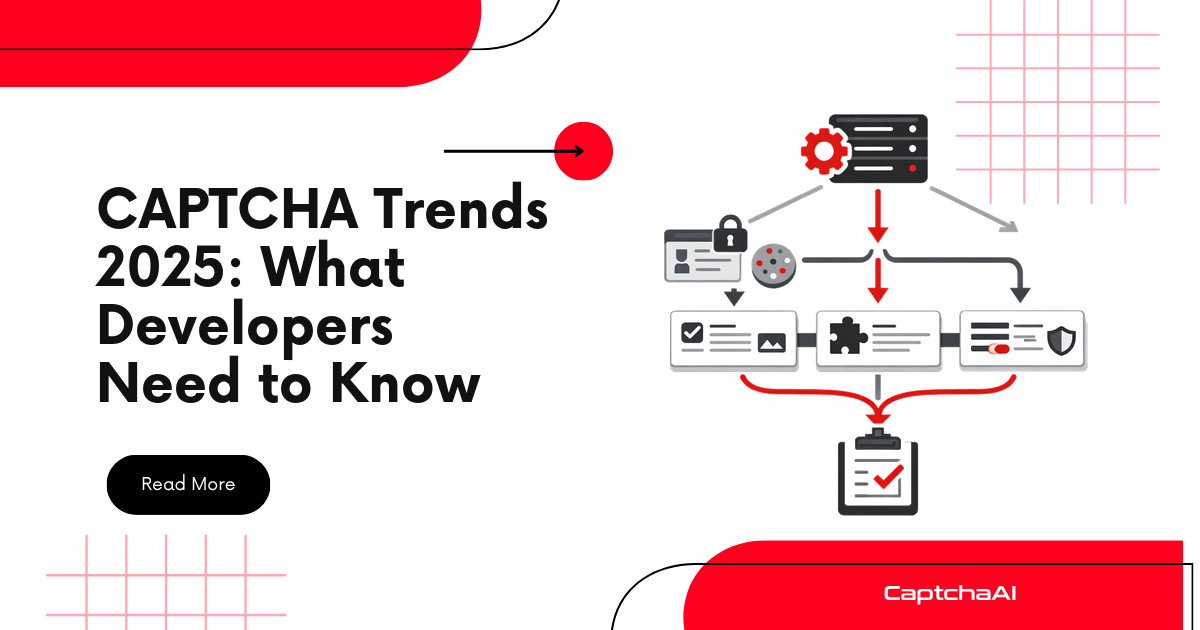
The CAPTCHA landscape is shifting. In 2025, the trend is toward invisible challenges, behavioral biometrics, and privacy-first solutions. Traditional visible CAPTCHAs — image grids, distorted text, audio challenges — are declining as they frustrate users and are increasingly solved by AI. For developers building automation workflows, these changes mean new challenge types, new detection methods, and new solver capabilities to track. Here is what matters in 2025.
Trend 1: Invisible CAPTCHAs become the default
Visible CAPTCHA challenges are disappearing. The shift from "prove you're human" to "we already know you're human" is accelerating.
Key developments
- Google reCAPTCHA v3 returns a score (0.0-1.0) with no visible challenge, letting websites decide the threshold
- Cloudflare Turnstile processes over 50 billion challenges per month, most resolved invisibly through browser proof-of-work
- hCaptcha Enterprise offers passive mode where most visitors see no challenge
- Apple Private Access Tokens let iOS/macOS users solve CAPTCHA challengess entirely using device attestation
What this means for developers
2020: Every form had a visible CAPTCHA checkbox or image grid
2023: ~40% of CAPTCHAs were invisible (score-based or passive)
2025: ~65% of enterprise deployments use invisible-first approaches
Impact on automation:
- Invisible CAPTCHAs cannot be "seen" in the page — they run as background JavaScript
- Solvers must handle token-based systems, not visual challenges
- Browser fingerprint quality matters more than ever (headless detection is the main signal)
- API-based solvers like CaptchaAI remain effective because they generate valid tokens regardless of the challenge visibility
Trend 2: AI vs AI — the arms race intensifies
AI models can now solve most visible CAPTCHAs that humans find difficult:
| Challenge type | AI solve rate (2025) | Human solve rate |
|---|---|---|
| Distorted text | 99%+ | 85-90% |
| Image grid (standard) | 95%+ | 90-95% |
| Image grid (ambiguous) | 80-85% | 70-80% |
| Audio challenge | 98%+ | 60-70% |
| Slider puzzle | 90%+ | 95%+ |
CAPTCHA providers respond with
- Behavioral biometrics — Analyzing mouse movement patterns, typing cadence, and touch gestures rather than challenge responses
- Multi-signal fusion — Combining 100+ browser, network, and behavioral signals into a single risk score
- Dynamic challenge generation — AI-generated challenges that are unique per session (not from a fixed image bank)
- Server-side validation strengthening — Tokens with shorter lifespans, stricter replay detection, domain binding
What this means for developers
- Visual challenge solving is getting easier (AI models improve faster than CAPTCHAs get harder)
- Detection is shifting from "can you solve this puzzle?" to "do you behave like a human?"
- API-based solvers adapt to new challenge types faster than custom scripts
- Browser-level stealth-configuredion is becoming as important as CAPTCHA solving
Trend 3: Privacy-first CAPTCHA solutions gain ground
Privacy regulations (GDPR, CCPA) and user backlash against data collection are driving demand for privacy-respecting CAPTCHA alternatives.
Privacy-focused approaches
| Solution | Privacy model | How it works |
|---|---|---|
| Cloudflare Turnstile | No user data collection | Browser proof-of-work + Cloudflare network signals |
| Apple Private Access Tokens | Zero-knowledge proof | Device attestation without revealing identity |
| Friendly Captcha | No cookies, no tracking | Cryptographic puzzle solved by browser |
| mCaptcha | Open source, privacy-first | Proof-of-work with adjustable difficulty |
Data collection comparison
reCAPTCHA:    Collects browsing history, cookies, mouse data → sends to Google
hCaptcha:     Collects interaction data → uses for ML training
Turnstile:    No personal data collection → uses network-level signals only
Friendly:     No data collection → purely computational proof-of-work
What this means for developers
- More diversity in CAPTCHA types to handle (not just reCAPTCHA/hCaptcha)
- Proof-of-work CAPTCHAs require different solving approaches than image/token CAPTCHAs
- Cookie-less visitors face fewer CAPTCHAs on privacy-first providers
- CaptchaAI continuously adds support for new CAPTCHA types as they gain market share
Trend 4: Bot management replaces standalone CAPTCHAs
CAPTCHAs are increasingly embedded within broader bot management platforms rather than standing alone.
Bot management platforms (2025)
| Platform | CAPTCHA component | Additional defenses |
|---|---|---|
| Cloudflare Bot Management | Turnstile | Rate limiting, WAF, JS challenge, managed rules |
| Akamai Bot Manager | Custom challenge | Behavioral signatures, device fingerprinting |
| DataDome | Custom CAPTCHA page | Real-time ML detection, API protection |
| PerimeterX (HUMAN) | Custom challenge | Behavioral biometrics, account protection |
| AWS WAF | AWS CAPTCHA | Token-based challenge, rate rules |
What this means for developers
- A single page may have multiple detection layers (CAPTCHA + fingerprinting + rate limiting)
- Solving the CAPTCHA alone may not be sufficient — you also need to pass browser fingerprint checks
- Proxy rotation and request timing are part of the stealth-configuredion strategy, not optional extras
- CaptchaAI solves the CAPTCHA layer; developers must handle the other layers (proxies, headers, timing)
Trend 5: Mobile and app CAPTCHAs expand
CAPTCHA challenges are appearing more frequently in mobile apps and APIs, not just web pages.
Mobile CAPTCHA patterns
- In-app WebViews — Same web CAPTCHAs rendered inside mobile apps
- App attestation — Google Play Integrity API and Apple App Attest verify the app itself
- Biometric verification — Face ID or fingerprint as CAPTCHA replacement
- Device attestation — Hardware-level verification that the device is genuine
API-level CAPTCHAs
APIs are now returning CAPTCHA challenges in JSON responses:
{
  "status": "captcha_required",
  "captcha_type": "recaptcha_v2",
  "site_key": "6Le-wvkSAAAAAPBMRTvw0Q4Muexq9bi0DJwx_mJ-",
  "action_url": "https://api.example.com/verify"
}
Instead of rendering a widget on a web page, the API consumer must solve the CAPTCHA and return the token in a subsequent request.
Trend 6: CAPTCHA solve costs continue to decline
Competition among CAPTCHA solving services drives prices down while accuracy improves.
Cost trends (per 1,000 solves)
| Year | Text CAPTCHA | reCAPTCHA v2 | reCAPTCHA v3 | Cloudflare Turnstile |
|---|---|---|---|---|
| 2021 | $1.00 | $2.99 | $3.50 | N/A |
| 2023 | $0.50 | $1.99 | $2.50 | $2.00 |
| 2025 | $0.30 | $1.20 | $1.50 | $1.00 |
Why costs are declining
- AI models reduce the need for human workers
- More solver providers increase competition
- Larger scale operations reduce per-solve marginal costs
- Standardized APIs reduce integration costs
CaptchaAI offers competitive pricing across all CAPTCHA types. Check current rates at captchaai.com.
What to build for in 2025
Developer checklist
| Area | Action |
|---|---|
| Invisible CAPTCHA handling | Ensure your automation can extract tokens from invisible reCAPTCHA v3 and Turnstile |
| Browser stealth-configuredion | Use browser configurations that pass fingerprint checks (real browser, standard APIs, no webdriver flag) |
| API-based solving | Use CaptchaAI or similar services for reliable solving regardless of challenge difficulty |
| Proxy infrastructure | Maintain residential proxy rotation to avoid IP reputation issues |
| Multi-layer handling | Build workflows that handle CAPTCHA + WAF + rate limiting as separate layers |
| Mobile awareness | Prepare for CAPTCHAs in API responses and mobile WebViews |
| Monitoring | Track solve rates and times to detect when providers change their challenge systems |
Frequently asked questions
Will CAPTCHAs be replaced entirely by 2025?
No. While invisible CAPTCHAs and behavioral analysis are reducing visible challenges, the underlying verification systems still exist. The challenge is moving from explicit user interaction to background verification. CAPTCHAs are evolving, not disappearing.
Which CAPTCHA type will dominate in 2025?
Cloudflare Turnstile is growing fastest due to its free pricing and privacy-first approach. reCAPTCHA remains the most deployed system overall. hCaptcha maintains a strong position in the enterprise segment. No single provider will dominate completely.
How does AI affect CAPTCHA solving accuracy?
AI has increased solving accuracy for most visual CAPTCHA types to 95%+ (text CAPTCHAs to 99%+). This is one reason providers are shifting to behavioral biometrics instead of visual challenges — AI solves visual puzzles better than many humans.
Is the CAPTCHA on a page always the same type?
No. Many providers use adaptive challenge selection. reCAPTCHA v2 may show a checkbox for trusted users, image grid for normal users, and audio challenge for accessibility requests — all on the same page. The challenge type is determined at runtime based on risk analysis.
Summary
The 2025 CAPTCHA landscape is defined by six trends: invisible-first challenges, AI arms race between solvers and providers, privacy-focused alternatives, bot management platform integration, mobile/API expansion, and declining solve costs. For developers, the key takeaway is that API-based solvers like CaptchaAI provide the most reliable and future-proof approach — they adapt to new challenge types and difficulty levels without requiring changes to your automation code.


Discussions (0)
Join the conversation
Sign in to share your opinion.
Sign InNo comments yet.