
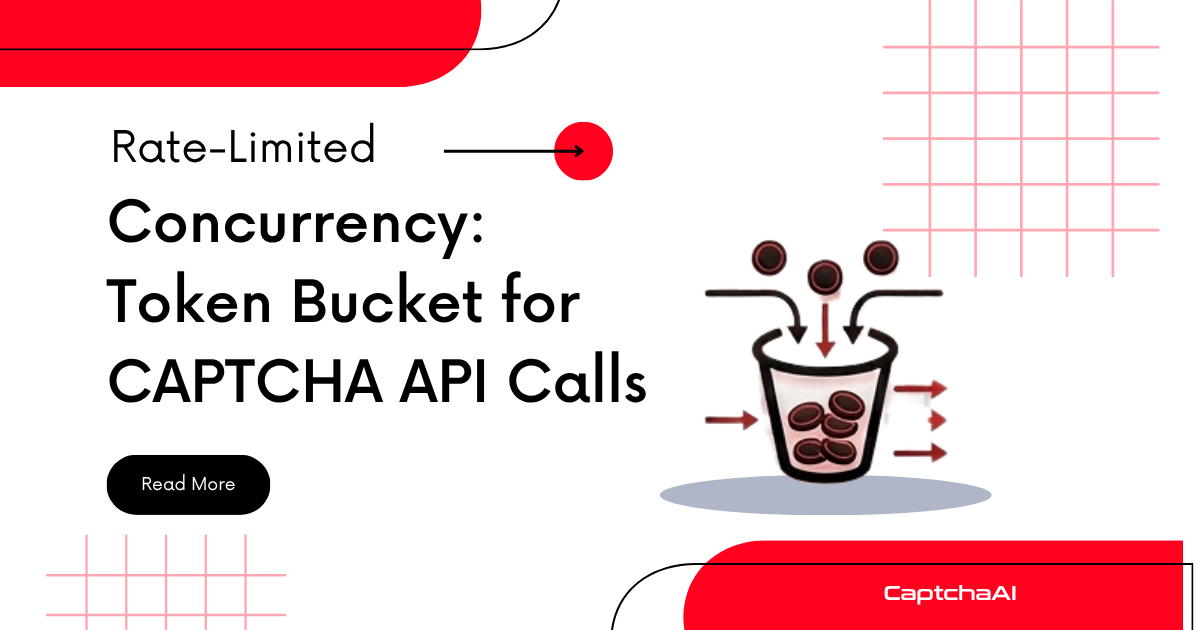
Sending 100 CAPTCHA tasks simultaneously sounds fast — until you hit rate limits. Semaphores let you cap the number of concurrent API calls to a safe level while keeping throughput high. This guide covers semaphore patterns for controlling CaptchaAI concurrency in Python and Node.js.
Why semaphores
| Without semaphore | With semaphore |
|---|---|
| 100 simultaneous requests | 20 at a time |
| 429 rate limit errors | No rate limit errors |
| Unpredictable timing | Steady throughput |
| Memory spikes | Controlled resource usage |
A semaphore is a counter that limits how many tasks can run at the same time. When a task acquires the semaphore, the count decreases. When it finishes, the count increases. If the count is zero, new tasks wait.
Python: asyncio.Semaphore
Basic pattern
import asyncio
import aiohttp

API_KEY = "YOUR_API_KEY"
SUBMIT_URL = "https://ocr.captchaai.com/in.php"
RESULT_URL = "https://ocr.captchaai.com/res.php"


async def solve_one(session, sem, sitekey, page_url):
    """Solve one CAPTCHA within the semaphore limit."""
    async with sem:
        # Submit
        async with session.post(SUBMIT_URL, data={
            "key": API_KEY,
            "method": "userrecaptcha",
            "googlekey": sitekey,
            "pageurl": page_url,
            "json": "1",
        }) as resp:
            data = await resp.json()

        if data["status"] != 1:
            return {"url": page_url, "error": data["request"]}

        task_id = data["request"]

        # Poll (still within semaphore)
        for _ in range(24):
            await asyncio.sleep(5)
            async with session.get(RESULT_URL, params={
                "key": API_KEY, "action": "get", "id": task_id, "json": "1"
            }) as resp:
                result = await resp.json()

            if result["status"] == 1:
                return {"url": page_url, "token": result["request"]}
            if result["request"] != "CAPCHA_NOT_READY":
                return {"url": page_url, "error": result["request"]}

        return {"url": page_url, "error": "TIMEOUT"}


async def solve_batch(tasks, max_concurrent=20):
    sem = asyncio.Semaphore(max_concurrent)

    async with aiohttp.ClientSession() as session:
        coros = [
            solve_one(session, sem, t["sitekey"], t["url"])
            for t in tasks
        ]
        results = await asyncio.gather(*coros)

    solved = sum(1 for r in results if "token" in r)
    print(f"Solved {solved}/{len(results)}")
    return results
Split submit and poll semaphores
Submitting is fast (< 1s). Polling takes 15-60s. Using separate semaphores lets you submit faster:
async def solve_split_sems(session, submit_sem, poll_sem, sitekey, page_url):
    # Submit phase — short, limited to 30 concurrent
    async with submit_sem:
        async with session.post(SUBMIT_URL, data={
            "key": API_KEY,
            "method": "userrecaptcha",
            "googlekey": sitekey,
            "pageurl": page_url,
            "json": "1",
        }) as resp:
            data = await resp.json()

    if data["status"] != 1:
        return {"error": data["request"]}

    task_id = data["request"]

    # Poll phase — longer, limited to 50 concurrent
    async with poll_sem:
        for _ in range(24):
            await asyncio.sleep(5)
            async with session.get(RESULT_URL, params={
                "key": API_KEY, "action": "get", "id": task_id, "json": "1"
            }) as resp:
                result = await resp.json()

            if result["status"] == 1:
                return {"token": result["request"]}
            if result["request"] != "CAPCHA_NOT_READY":
                return {"error": result["request"]}

    return {"error": "TIMEOUT"}


async def main(tasks):
    submit_sem = asyncio.Semaphore(30)  # 30 concurrent submits
    poll_sem = asyncio.Semaphore(50)     # 50 concurrent polls

    async with aiohttp.ClientSession() as session:
        coros = [
            solve_split_sems(session, submit_sem, poll_sem, t["sitekey"], t["url"])
            for t in tasks
        ]
        return await asyncio.gather(*coros)
Node.js: Custom semaphore
Node.js doesn't have a built-in semaphore, but it's simple to build:
class Semaphore {
  constructor(max) {
    this.max = max;
    this.current = 0;
    this.queue = [];
  }

  acquire() {
    return new Promise(resolve => {
      if (this.current < this.max) {
        this.current++;
        resolve();
      } else {
        this.queue.push(resolve);
      }
    });
  }

  release() {
    this.current--;
    if (this.queue.length > 0) {
      this.current++;
      const next = this.queue.shift();
      next();
    }
  }
}
Using the semaphore
const axios = require('axios');

const API_KEY = 'YOUR_API_KEY';
const sem = new Semaphore(20);

async function solveOne(sitekey, pageUrl) {
  await sem.acquire();
  try {
    const submit = await axios.post('https://ocr.captchaai.com/in.php', null, {
      params: {
        key: API_KEY,
        method: 'userrecaptcha',
        googlekey: sitekey,
        pageurl: pageUrl,
        json: 1,
      },
    });

    if (submit.data.status !== 1) {
      return { url: pageUrl, error: submit.data.request };
    }

    const taskId = submit.data.request;

    for (let i = 0; i < 24; i++) {
      await new Promise(r => setTimeout(r, 5000));
      const poll = await axios.get('https://ocr.captchaai.com/res.php', {
        params: { key: API_KEY, action: 'get', id: taskId, json: 1 },
      });

      if (poll.data.status === 1) {
        return { url: pageUrl, token: poll.data.request };
      }
      if (poll.data.request !== 'CAPCHA_NOT_READY') {
        return { url: pageUrl, error: poll.data.request };
      }
    }
    return { url: pageUrl, error: 'TIMEOUT' };
  } finally {
    sem.release();
  }
}

// Solve 100 tasks with max 20 concurrent
async function solveBatch(tasks) {
  const results = await Promise.all(
    tasks.map(t => solveOne(t.sitekey, t.url))
  );
  const solved = results.filter(r => r.token).length;
  console.log(`Solved: ${solved}/${results.length}`);
  return results;
}
Adaptive semaphore
Adjust concurrency based on error rates:
class AdaptiveSemaphore:
    def __init__(self, initial=20, min_val=5, max_val=50):
        self.value = initial
        self.min_val = min_val
        self.max_val = max_val
        self.sem = asyncio.Semaphore(initial)
        self.success_count = 0
        self.error_count = 0

    async def acquire(self):
        await self.sem.acquire()

    def release(self, success=True):
        self.sem.release()
        if success:
            self.success_count += 1
        else:
            self.error_count += 1

        total = self.success_count + self.error_count
        if total % 20 == 0:
            self._adjust()

    def _adjust(self):
        error_rate = self.error_count / (self.success_count + self.error_count)

        if error_rate > 0.2 and self.value > self.min_val:
            self.value = max(self.min_val, self.value - 5)
            self.sem = asyncio.Semaphore(self.value)
            print(f"Reduced concurrency to {self.value}")
        elif error_rate < 0.05 and self.value < self.max_val:
            self.value = min(self.max_val, self.value + 5)
            self.sem = asyncio.Semaphore(self.value)
            print(f"Increased concurrency to {self.value}")

        self.success_count = 0
        self.error_count = 0
Troubleshooting
| Problem | Cause | Fix |
|---|---|---|
| All tasks blocked | Semaphore never released | Use try/finally to always release |
| Still getting 429s | Semaphore too high | Reduce max concurrent value |
| Too slow | Semaphore too low | Increase value or split submit/poll |
| Memory growing | Tasks queued forever | Set a timeout on acquire() |
FAQ
What concurrency level should I use?
Start with 20 concurrent tasks. If you see no 429 errors, increase to 30-50. If you see errors, reduce to 10-15.
Should I limit submits or polls?
Limit submits more aggressively. Polls are lightweight GET requests and can run at higher concurrency.
Scale your CAPTCHA solving with CaptchaAI
Get your API key at captchaai.com.







Discussions (0)
Join the conversation
Sign in to share your opinion.
Sign InNo comments yet.