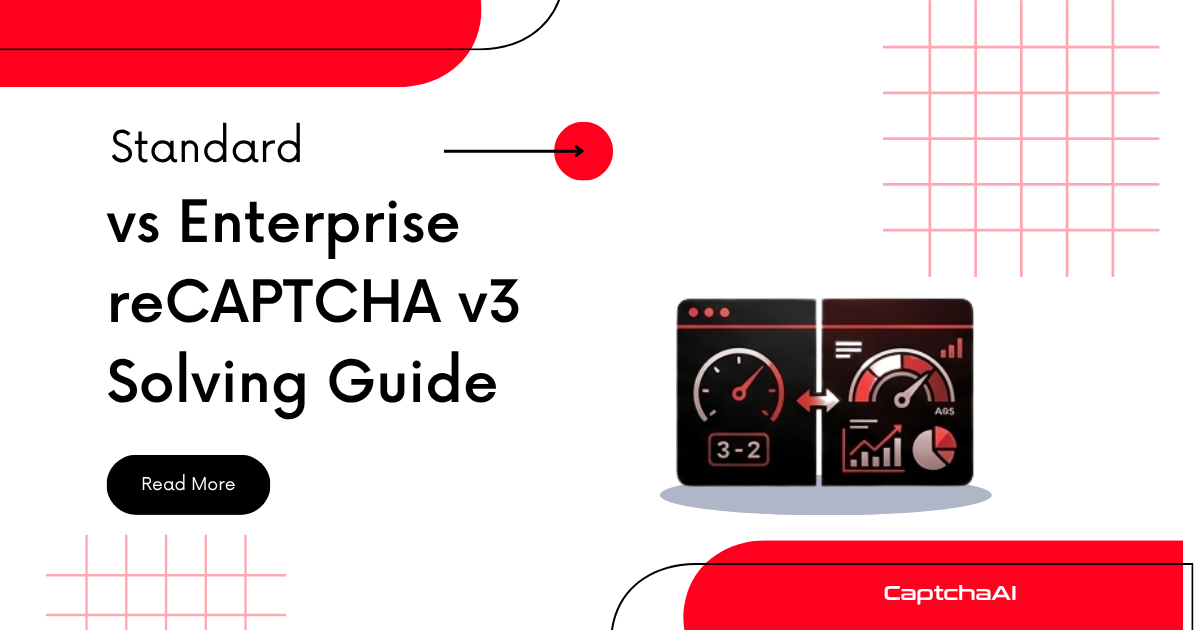
Both versions run invisibly and return a risk score (0.0 to 1.0). Enterprise adds reason codes, adaptive thresholds, and Google Cloud project management — but from a CaptchaAI solving perspective, the only parameter difference is enterprise=1. The challenge is detecting which version a site uses, since both are invisible.
Feature comparison
| Feature | Standard v3 | Enterprise v3 |
|---|---|---|
| Invisible operation | Yes | Yes |
| Score (0.0–1.0) | Yes | Yes |
| Action parameter | Required | Required |
| JS file | api.js?render=KEY |
enterprise.js?render=KEY |
| Execute function | grecaptcha.execute() |
grecaptcha.enterprise.execute() |
| Reason codes | No | Yes (AUTOMATION, TOO_MUCH_TRAFFIC, etc.) |
| Custom thresholds per action | No | Yes (via Cloud Console) |
| Password leak detection | No | Yes |
| Account defender | No | Yes |
| Verification endpoint | siteverify (free) |
recaptchaenterprise.googleapis.com (paid) |
| CaptchaAI params | version=v3 |
version=v3 + enterprise=1 |
| Typical solve time | 10-20 seconds | 10-20 seconds |
How to detect which version a site uses
Since both versions are invisible (no visible widget), detection must rely on the JavaScript:
Python detection:
import requests
import re

def detect_v3_type(url):
    resp = requests.get(url)
    html = resp.text

    # Check for enterprise.js
    if "enterprise.js" in html:
        version = "enterprise_v3"
        execute_fn = "grecaptcha.enterprise.execute"
    elif "recaptcha/api.js" in html and "render=" in html:
        version = "standard_v3"
        execute_fn = "grecaptcha.execute"
    else:
        return None

    # Extract sitekey from render parameter
    key_match = re.search(r'render[=:]\s*["\']?([A-Za-z0-9_-]{40})', html)
    sitekey = key_match.group(1) if key_match else None

    # Extract action parameter
    action_match = re.search(r'action["\']?\s*[:=]\s*["\'](\w+)', html)
    action = action_match.group(1) if action_match else "unknown"

    return {
        "version": version,
        "sitekey": sitekey,
        "action": action,
        "execute_fn": execute_fn
    }

info = detect_v3_type("https://example.com/login")
print(info)
Node.js detection:
const axios = require("axios");

async function detectV3Type(url) {
  const { data: html } = await axios.get(url);

  let version, executeFn;
  if (html.includes("enterprise.js")) {
    version = "enterprise_v3";
    executeFn = "grecaptcha.enterprise.execute";
  } else if (html.includes("recaptcha/api.js") && html.includes("render=")) {
    version = "standard_v3";
    executeFn = "grecaptcha.execute";
  } else {
    return null;
  }

  const keyMatch = html.match(/render[=:]\s*['"]?([A-Za-z0-9_-]{40})/);
  const actionMatch = html.match(/action['"]?\s*[:=]\s*['"](\w+)/);

  return {
    version,
    sitekey: keyMatch?.[1] || null,
    action: actionMatch?.[1] || "unknown",
    executeFn,
  };
}
Browser console quick check:
// Paste in DevTools console
if (document.querySelector('script[src*="enterprise.js"]')) {
  console.log("Enterprise v3");
  console.log("Execute:", typeof grecaptcha?.enterprise?.execute);
} else if (document.querySelector('script[src*="api.js"][src*="render="]')) {
  console.log("Standard v3");
  console.log("Execute:", typeof grecaptcha?.execute);
}
Solving with CaptchaAI
Standard v3
import requests
import time

# Submit
resp = requests.get("https://ocr.captchaai.com/in.php", params={
    "key": "YOUR_API_KEY",
    "method": "userrecaptcha",
    "version": "v3",
    "googlekey": sitekey,
    "action": "login",
    "pageurl": page_url
})
task_id = resp.text.split("|")[1]

# Poll
for _ in range(60):
    time.sleep(5)
    result = requests.get("https://ocr.captchaai.com/res.php", params={
        "key": "YOUR_API_KEY", "action": "get", "id": task_id
    })
    if result.text.startswith("OK|"):
        token = result.text.split("|")[1]
        break
Enterprise v3
import requests
import time

# Submit — add enterprise=1
resp = requests.get("https://ocr.captchaai.com/in.php", params={
    "key": "YOUR_API_KEY",
    "method": "userrecaptcha",
    "version": "v3",
    "enterprise": 1,  # Required for Enterprise
    "googlekey": sitekey,
    "action": "login",
    "pageurl": page_url
})
task_id = resp.text.split("|")[1]

# Polling is identical to standard
for _ in range(60):
    time.sleep(5)
    result = requests.get("https://ocr.captchaai.com/res.php", params={
        "key": "YOUR_API_KEY", "action": "get", "id": task_id
    })
    if result.text.startswith("OK|"):
        token = result.text.split("|")[1]
        break
Universal solver with auto-detection
import requests
import time
import re

class RecaptchaV3Solver:
    def __init__(self, api_key):
        self.api_key = api_key

    def detect_and_solve(self, page_url, action=None):
        """Auto-detect standard vs enterprise and solve."""
        html = requests.get(page_url).text

        is_enterprise = "enterprise.js" in html
        key_match = re.search(r'render[=:]\s*["\']?([A-Za-z0-9_-]{40})', html)
        if not key_match:
            raise Exception("No v3 sitekey found")
        sitekey = key_match.group(1)

        if not action:
            action_match = re.search(r'action["\']?\s*[:=]\s*["\'](\w+)', html)
            action = action_match.group(1) if action_match else "verify"

        params = {
            "key": self.api_key,
            "method": "userrecaptcha",
            "version": "v3",
            "googlekey": sitekey,
            "action": action,
            "pageurl": page_url
        }
        if is_enterprise:
            params["enterprise"] = 1

        resp = requests.get("https://ocr.captchaai.com/in.php", params=params)
        if not resp.text.startswith("OK|"):
            raise Exception(f"Submit failed: {resp.text}")

        task_id = resp.text.split("|")[1]
        for _ in range(60):
            time.sleep(5)
            result = requests.get("https://ocr.captchaai.com/res.php", params={
                "key": self.api_key, "action": "get", "id": task_id
            })
            if result.text.startswith("OK|"):
                return result.text.split("|")[1]
            if result.text != "CAPCHA_NOT_READY":
                raise Exception(f"Solve failed: {result.text}")

        raise Exception("Timed out")

solver = RecaptchaV3Solver("YOUR_API_KEY")
token = solver.detect_and_solve("https://example.com/login", action="login")
print(f"Token: {token[:40]}...")
Common mistakes
| Mistake | Result | Fix |
|---|---|---|
Using enterprise=1 on standard v3 |
Token may be invalid | Check for enterprise.js before adding flag |
Omitting enterprise=1 on Enterprise v3 |
Token rejected by backend | Always add when enterprise.js is present |
Wrong action parameter |
Low score, token rejected | Extract the exact action string from page JavaScript |
Omitting version=v3 |
Solver treats it as v2 | Always include version=v3 for score-based reCAPTCHA |
| Using v2 sitekey for v3 solve | ERROR_WRONG_GOOGLEKEY |
v3 sitekeys come from render=KEY parameter |
Extracting the action parameter
The action parameter is critical for v3 — both standard and enterprise. If you send the wrong action, the score will be low and the token may be rejected.
import re

def find_v3_actions(html):
    """Extract all action parameters from page JavaScript."""
    # Look for grecaptcha.execute(key, {action: '...'})
    pattern = r"(?:grecaptcha\.(?:enterprise\.)?execute|action)\s*[(:]\s*['\"](\w+)"
    actions = re.findall(pattern, html)
    return list(set(actions))

# Common actions: "login", "submit", "register", "checkout", "homepage"
Token injection
Same approach for both versions:
# For browser-based workflows (Selenium)
driver.execute_script(
    f'document.getElementById("g-recaptcha-response").value = "{token}";'
)

# For pure HTTP workflows
requests.post(page_url, data={
    "g-recaptcha-response": token,
    "username": "user",
    "password": "pass"
})
// Puppeteer
await page.evaluate((tok) => {
  document.getElementById("g-recaptcha-response").value = tok;
}, token);

// Pure HTTP (axios)
await axios.post(pageUrl, new URLSearchParams({
  "g-recaptcha-response": token,
  username: "user",
  password: "pass",
}));
FAQ
Does Enterprise v3 give different scores?
The scoring model is similar, but Enterprise may use additional signals and custom thresholds. CaptchaAI handles both identically — the returned token works regardless of which model Google uses.
How do I detect Enterprise v3 on a page?
Look for enterprise.js instead of api.js in the script tag, and grecaptcha.enterprise.execute() in the JavaScript. Both are invisible, so there is no visual difference.
Is Enterprise v3 more expensive to solve?
Check CaptchaAI's current pricing. Enterprise solves may be priced differently, but the API integration effort is identical to standard.
What if I cannot find the action parameter?
Try common values: "verify", "submit", "homepage", "login". If the token is still rejected, use browser DevTools to search for execute( in the page scripts and find the exact action string.
Can a site switch between standard and enterprise without notice?
Yes. Sites can migrate to Enterprise at any time. Build your detection to run on every page load rather than hardcoding the version.
Related guides
- reCAPTCHA v3 Enterprise vs Standard — alternative comparison angle
- reCAPTCHA Enterprise vs Standard — Complete Guide — covers all versions
- How to Solve reCAPTCHA v3 Using API — standard v3 tutorial
- How to Solve reCAPTCHA v3 Enterprise Using API — enterprise v3 tutorial
- reCAPTCHA v3 Action Parameter Explained — action parameter deep dive
FAQ
Will using the wrong enterprise flag cause failures?
Often yes. Sites that use Enterprise verify tokens against the Enterprise API, which expects Enterprise tokens. Standard tokens may fail verification, and vice versa.
How do I detect Enterprise v3 programmatically?
Search the page source for enterprise.js:
page_source = driver.page_source
is_enterprise = "enterprise.js" in page_source
Is there a performance difference?
No. Solving time and success rates are similar for both versions.
Discussions (0)
Join the conversation
Sign in to share your opinion.
Sign InNo comments yet.