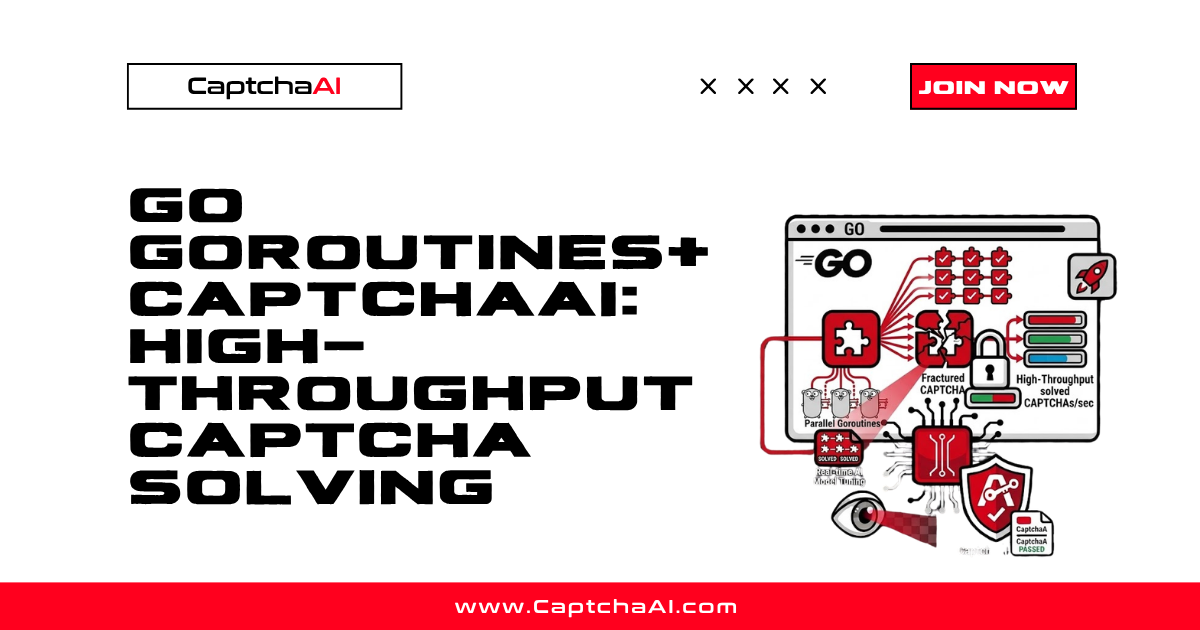
Go's goroutines and channels make it one of the best languages for CAPTCHA solving at scale. Thousands of concurrent solves use minimal memory, and the standard library handles HTTP without external dependencies.
Basic solver
package main

import (
    "encoding/json"
    "fmt"
    "io"
    "net/http"
    "net/url"
    "time"
)

const (
    submitURL = "https://ocr.captchaai.com/in.php"
    resultURL = "https://ocr.captchaai.com/res.php"
    apiKey    = "YOUR_API_KEY"
)

type APIResponse struct {
    Status  int    `json:"status"`
    Request string `json:"request"`
}

func solveCaptcha(method string, params map[string]string) (string, error) {
    // Submit
    data := url.Values{
        "key":    {apiKey},
        "method": {method},
        "json":   {"1"},
    }
    for k, v := range params {
        data.Set(k, v)
    }

    resp, err := http.PostForm(submitURL, data)
    if err != nil {
        return "", fmt.Errorf("submit request failed: %w", err)
    }
    defer resp.Body.Close()

    var submitResult APIResponse
    if err := json.NewDecoder(resp.Body).Decode(&submitResult); err != nil {
        return "", fmt.Errorf("submit decode failed: %w", err)
    }

    if submitResult.Status != 1 {
        return "", fmt.Errorf("submit error: %s", submitResult.Request)
    }

    taskID := submitResult.Request

    // Poll
    for i := 0; i < 24; i++ {
        time.Sleep(5 * time.Second)

        pollURL := fmt.Sprintf("%s?key=%s&action=get&id=%s&json=1",
            resultURL, apiKey, taskID)
        pollResp, err := http.Get(pollURL)
        if err != nil {
            continue
        }
        body, _ := io.ReadAll(pollResp.Body)
        pollResp.Body.Close()

        var pollResult APIResponse
        if err := json.Unmarshal(body, &pollResult); err != nil {
            continue
        }

        if pollResult.Status == 1 {
            return pollResult.Request, nil
        }
        if pollResult.Request != "CAPCHA_NOT_READY" {
            return "", fmt.Errorf("poll error: %s", pollResult.Request)
        }
    }

    return "", fmt.Errorf("timeout: task %s", taskID)
}

func main() {
    token, err := solveCaptcha("userrecaptcha", map[string]string{
        "googlekey": "6Le-SITEKEY",
        "pageurl":   "https://example.com",
    })
    if err != nil {
        fmt.Printf("Error: %v\n", err)
        return
    }
    fmt.Printf("Token: %.50s...\n", token)
}
Expected output:
Token: 03AGdBq26ZfPxL...
Concurrent solving with WaitGroup
package main

import (
    "encoding/json"
    "fmt"
    "io"
    "net/http"
    "net/url"
    "sync"
    "time"
)

const (
    submitURL     = "https://ocr.captchaai.com/in.php"
    resultURL     = "https://ocr.captchaai.com/res.php"
    apiKey        = "YOUR_API_KEY"
    maxConcurrent = 10
)

type APIResponse struct {
    Status  int    `json:"status"`
    Request string `json:"request"`
}

type SolveResult struct {
    Index int
    Token string
    Error error
}

func solveCaptcha(method string, params map[string]string) (string, error) {
    data := url.Values{"key": {apiKey}, "method": {method}, "json": {"1"}}
    for k, v := range params {
        data.Set(k, v)
    }

    resp, err := http.PostForm(submitURL, data)
    if err != nil {
        return "", err
    }
    defer resp.Body.Close()

    var result APIResponse
    json.NewDecoder(resp.Body).Decode(&result)

    if result.Status != 1 {
        return "", fmt.Errorf(result.Request)
    }

    taskID := result.Request
    for i := 0; i < 24; i++ {
        time.Sleep(5 * time.Second)
        pollResp, err := http.Get(fmt.Sprintf("%s?key=%s&action=get&id=%s&json=1",
            resultURL, apiKey, taskID))
        if err != nil {
            continue
        }
        body, _ := io.ReadAll(pollResp.Body)
        pollResp.Body.Close()

        var pr APIResponse
        json.Unmarshal(body, &pr)
        if pr.Status == 1 {
            return pr.Request, nil
        }
        if pr.Request != "CAPCHA_NOT_READY" {
            return "", fmt.Errorf(pr.Request)
        }
    }
    return "", fmt.Errorf("timeout")
}

func main() {
    var wg sync.WaitGroup
    sem := make(chan struct{}, maxConcurrent)
    results := make(chan SolveResult, 20)

    // Launch 20 concurrent solves
    for i := 0; i < 20; i++ {
        wg.Add(1)
        go func(index int) {
            defer wg.Done()
            sem <- struct{}{}        // acquire
            defer func() { <-sem }() // release

            token, err := solveCaptcha("userrecaptcha", map[string]string{
                "googlekey": fmt.Sprintf("6Le-SITEKEY-%d", index),
                "pageurl":   fmt.Sprintf("https://example.com/page/%d", index),
            })
            results <- SolveResult{Index: index, Token: token, Error: err}
        }(i)
    }

    // Close results channel when all done
    go func() {
        wg.Wait()
        close(results)
    }()

    // Collect results
    solved, failed := 0, 0
    for r := range results {
        if r.Error != nil {
            fmt.Printf("[task-%d] Failed: %v\n", r.Index, r.Error)
            failed++
        } else {
            fmt.Printf("[task-%d] Solved: %.40s...\n", r.Index, r.Token)
            solved++
        }
    }
    fmt.Printf("\nResults: %d solved, %d failed\n", solved, failed)
}
Expected output:
[task-0] Solved: 03AGdBq26ZfPxL...
[task-3] Solved: 03AGdBq27AbCdE...
...
Results: 18 solved, 2 failed
Channel-based worker pool
For production, use a worker pool with input/output channels:
type CaptchaTask struct {
    Index  int
    Method string
    Params map[string]string
}

func worker(id int, tasks <-chan CaptchaTask, results chan<- SolveResult) {
    for task := range tasks {
        token, err := solveCaptcha(task.Method, task.Params)
        results <- SolveResult{Index: task.Index, Token: token, Error: err}
    }
}

func runWorkerPool(taskList []CaptchaTask, workerCount int) []SolveResult {
    tasks := make(chan CaptchaTask, len(taskList))
    results := make(chan SolveResult, len(taskList))

    // Start workers
    for i := 0; i < workerCount; i++ {
        go worker(i, tasks, results)
    }

    // Send tasks
    for _, t := range taskList {
        tasks <- t
    }
    close(tasks)

    // Collect results
    var all []SolveResult
    for i := 0; i < len(taskList); i++ {
        all = append(all, <-results)
    }
    return all
}
HTTP client tuning
Use a shared client with connection pooling:
var client = &http.Client{
    Transport: &http.Transport{
        MaxIdleConns:        100,
        MaxIdleConnsPerHost: 50,
        IdleConnTimeout:     30 * time.Second,
    },
    Timeout: 15 * time.Second,
}
Replace http.PostForm and http.Get with client.PostForm and client.Get.
Troubleshooting
| Problem | Cause | Fix |
|---|---|---|
connection reset |
Too many concurrent connections | Lower maxConcurrent, tune MaxIdleConnsPerHost |
| Goroutine leak | No timeout on HTTP calls | Set http.Client.Timeout |
| All tasks timeout | API under load | Increase poll loop from 24 to 36 iterations |
| Panic on closed channel | Writing to closed results channel | Ensure close() is called after all writes |
FAQ
How many goroutines can I run?
Go supports thousands of goroutines. The limiting factor is CaptchaAI's concurrency limit, not Go. Use the semaphore pattern to match your account's capacity.
Should I use goroutines or the worker pool pattern?
Use goroutines with semaphore for simple batches. Use the worker pool for long-running services where tasks arrive continuously.
How does this compare to Python asyncio?
Go goroutines are lighter than Python coroutines and handle more concurrent I/O with less overhead. For pure HTTP-based CAPTCHA solving, Go is typically 2-3x faster at high concurrency.
Start high-throughput CAPTCHA solving with CaptchaAI
Get your API key at captchaai.com.
Related guides
- CAPTCHA Solving with Go
- Parallel CAPTCHA Solving
- Retry Queue with Exponential Backoff
- Python asyncio + CaptchaAI
Full Working Code
Complete runnable examples for this article in Python, Node.js, PHP, Go, Java, C#, Ruby, Rust, Kotlin & Bash.
View on GitHub →

Discussions (0)
Join the conversation
Sign in to share your opinion.
Sign InNo comments yet.