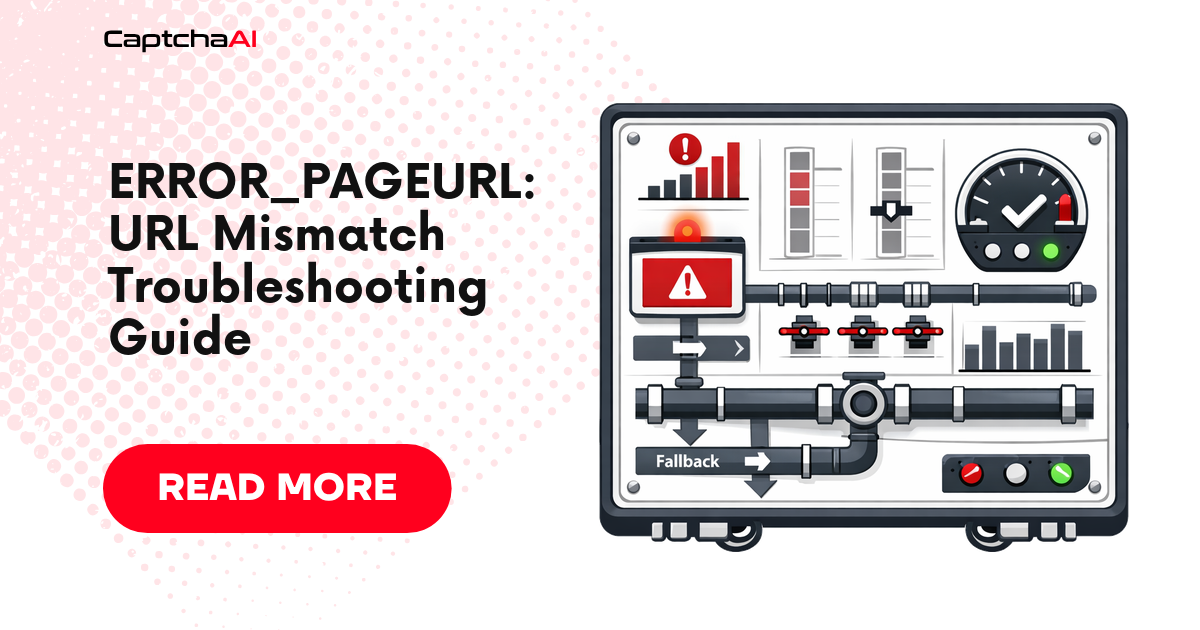
ERROR_PAGEURL means the pageurl parameter doesn't match where the CAPTCHA is loaded. Solvers validate tokens against the origin domain, so the URL must be correct.
Common Causes
| Cause | Example |
|---|---|
| Missing protocol | example.com instead of https://example.com |
| Wrong domain | www.example.com vs example.com |
| Redirect changed URL | Form at /login redirected to /auth/login |
| SPA route mismatch | JS route /app/login not matching server URL |
| URL encoding issues | Spaces or special chars not encoded |
| Iframe from different domain | CAPTCHA loaded from subdomain |
How to Get the Correct URL
Rule: Use the URL in the browser address bar where the CAPTCHA is visible.
# WRONG — incomplete URL
pageurl = "example.com/login"

# WRONG — wrong protocol
pageurl = "http://example.com/login"

# CORRECT — full URL with protocol
pageurl = "https://example.com/login"

# CORRECT — with www if that's what the page uses
pageurl = "https://www.example.com/login"
URL Validation Helper
from urllib.parse import urlparse


def validate_pageurl(url):
    """Validate pageurl before API submission."""
    parsed = urlparse(url)

    if not parsed.scheme:
        raise ValueError(f"Missing protocol: {url}. Use https://")

    if parsed.scheme not in ("http", "https"):
        raise ValueError(f"Invalid protocol: {parsed.scheme}")

    if not parsed.netloc:
        raise ValueError(f"Missing domain: {url}")

    # Remove fragment (hash) — not sent to server
    clean = f"{parsed.scheme}://{parsed.netloc}{parsed.path}"
    if parsed.query:
        clean += f"?{parsed.query}"

    return clean


# Usage
url = validate_pageurl("https://example.com/login#section")
# Returns: "https://example.com/login"
Handling Redirects
import requests


def get_final_url(url):
    """Follow redirects to get the actual page URL."""
    resp = requests.get(url, allow_redirects=True, timeout=15)
    return resp.url


# If the login page redirects
original = "https://example.com/login"
final = get_final_url(original)
print(f"Final URL: {final}")
# Use final URL as pageurl
Handling SPAs (Single Page Applications)
SPAs change the URL via JavaScript without full page loads. The CAPTCHA's domain is what matters:
# For SPAs, use the domain root + the route shown in the address bar
# NOT the API endpoint that the form submits to

# WRONG — API endpoint
pageurl = "https://api.example.com/v1/auth/login"

# CORRECT — the page URL shown in browser
pageurl = "https://example.com/login"
Iframe-Loaded CAPTCHAs
When a CAPTCHA loads inside an iframe from a different domain:
# If the CAPTCHA is on the MAIN page
pageurl = "https://example.com/register"  # Main page URL

# If the CAPTCHA is in an IFRAME with a different domain
# Still use the main page URL, not the iframe src
pageurl = "https://example.com/register"
# NOT: "https://captcha-frame.example.com/challenge"
Correct Submission
import requests

# Validate URL first
pageurl = validate_pageurl("https://example.com/login")

resp = requests.post("https://ocr.captchaai.com/in.php", data={
    "key": "YOUR_API_KEY",
    "method": "userrecaptcha",
    "googlekey": "SITE_KEY",
    "pageurl": pageurl,
    "json": 1,
})
result = resp.json()

if result.get("status") == 1:
    print(f"Task ID: {result['request']}")
else:
    print(f"Error: {result.get('request')}")
Troubleshooting
| Issue | Cause | Fix |
|---|---|---|
| Error despite correct-looking URL | www vs non-www mismatch | Check address bar exactly |
| URL works sometimes, fails others | Page has A/B test URLs | Capture URL at solve time |
| Token solved but rejected by site | pageurl domain mismatch | Token domain must match site domain |
| Works in browser but fails in code | Redirect not followed | Use get_final_url() |
| URL has query parameters | Parameters may be required | Include necessary query params |
FAQ
Does the URL path matter or just the domain?
The domain is the critical part for token validation. However, provide the full path for best results, as some sites validate the complete URL.
Should I include query parameters?
Include them if they're part of the visible URL. Remove tracking parameters like utm_source that don't affect the page content.
How do I handle URLs that change per session?
Extract the URL dynamically in your automation script. Don't hardcode URLs that include session IDs or tokens.
Related Guides
Get the URL right — solve with CaptchaAI.




Discussions (0)
Join the conversation
Sign in to share your opinion.
Sign InNo comments yet.