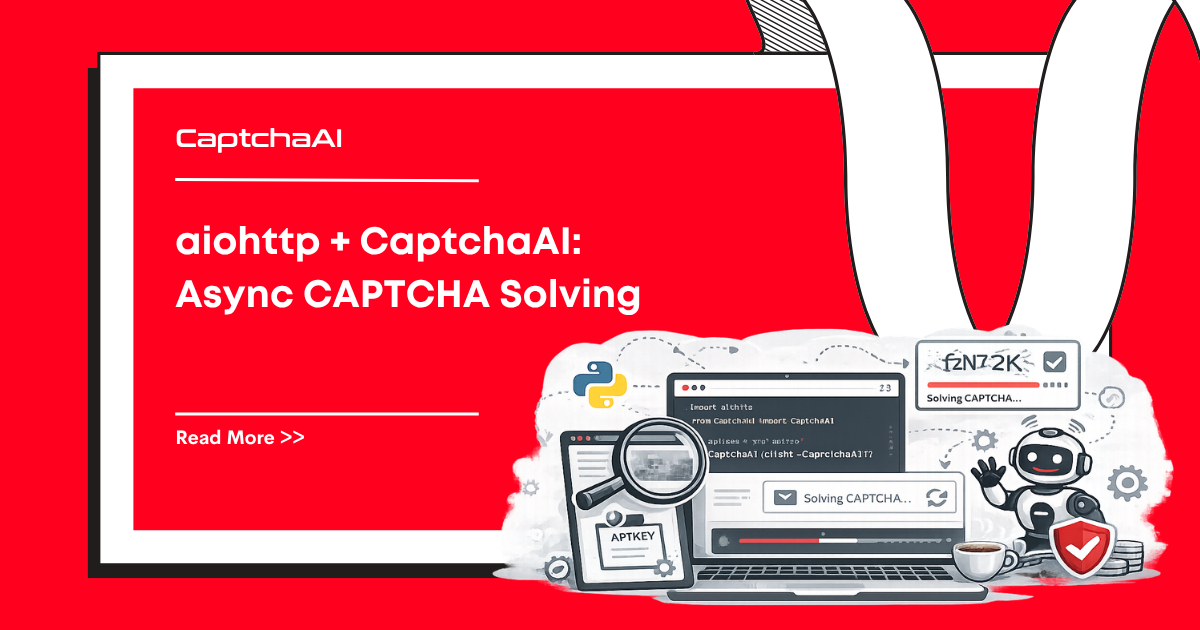
aiohttp enables non-blocking HTTP requests in Python. Combine it with CaptchaAI to solve multiple CAPTCHAs concurrently without blocking your event loop.
Requirements
| Requirement | Details |
|---|---|
| Python | 3.8+ |
| aiohttp | 3.8+ |
| CaptchaAI API key | Get one here |
pip install aiohttp
Async CaptchaAI Client
import aiohttp
import asyncio


class AsyncCaptchaAI:
    def __init__(self, api_key):
        self.api_key = api_key
        self.base_url = "https://ocr.captchaai.com"

    async def submit(self, session, params):
        """Submit a CAPTCHA task and return the task ID."""
        params["key"] = self.api_key
        async with session.get(
            f"{self.base_url}/in.php", params=params
        ) as resp:
            text = await resp.text()

        if not text.startswith("OK|"):
            raise Exception(f"Submit failed: {text}")

        return text.split("|")[1]

    async def poll(self, session, task_id, timeout=300):
        """Poll for the result with a timeout."""
        params = {
            "key": self.api_key,
            "action": "get",
            "id": task_id,
        }
        deadline = asyncio.get_event_loop().time() + timeout

        while asyncio.get_event_loop().time() < deadline:
            await asyncio.sleep(5)

            async with session.get(
                f"{self.base_url}/res.php", params=params
            ) as resp:
                text = await resp.text()

            if text == "CAPCHA_NOT_READY":
                continue
            if text.startswith("OK|"):
                return text.split("|", 1)[1]
            raise Exception(f"Solve failed: {text}")

        raise TimeoutError(f"Task {task_id} timed out after {timeout}s")

    async def solve(self, session, params, timeout=300):
        """Submit and poll in one call."""
        task_id = await self.submit(session, params)
        return await self.poll(session, task_id, timeout)

    async def get_balance(self, session):
        """Check account balance."""
        params = {"key": self.api_key, "action": "getbalance"}
        async with session.get(
            f"{self.base_url}/res.php", params=params
        ) as resp:
            return float(await resp.text())
Solve a Single CAPTCHA
import asyncio
import os

async def main():
    solver = AsyncCaptchaAI(os.environ["CAPTCHAAI_API_KEY"])

    async with aiohttp.ClientSession() as session:
        # Check balance
        balance = await solver.get_balance(session)
        print(f"Balance: ${balance:.2f}")

        # Solve reCAPTCHA v2
        token = await solver.solve(session, {
            "method": "userrecaptcha",
            "googlekey": "6Le-wvkS...",
            "pageurl": "https://example.com",
        })
        print(f"Token: {token[:50]}...")

asyncio.run(main())
Solve Multiple CAPTCHAs Concurrently
async def solve_batch(urls, site_key):
    solver = AsyncCaptchaAI(os.environ["CAPTCHAAI_API_KEY"])

    async with aiohttp.ClientSession() as session:
        tasks = [
            solver.solve(session, {
                "method": "userrecaptcha",
                "googlekey": site_key,
                "pageurl": url,
            })
            for url in urls
        ]

        results = await asyncio.gather(*tasks, return_exceptions=True)

        for url, result in zip(urls, results):
            if isinstance(result, Exception):
                print(f"FAILED {url}: {result}")
            else:
                print(f"SOLVED {url}: {len(result)} chars")

        return results


urls = [
    "https://example.com/page1",
    "https://example.com/page2",
    "https://example.com/page3",
    "https://example.com/page4",
    "https://example.com/page5",
]
asyncio.run(solve_batch(urls, "6Le-wvkS..."))
Scraping with CAPTCHA Handling
async def scrape_with_captcha(url, site_key):
    solver = AsyncCaptchaAI(os.environ["CAPTCHAAI_API_KEY"])

    async with aiohttp.ClientSession() as session:
        # Fetch the page
        async with session.get(url) as resp:
            html = await resp.text()

        # Check if page has a CAPTCHA
        if "g-recaptcha" not in html:
            return html  # No CAPTCHA, return content

        # Solve the CAPTCHA
        token = await solver.solve(session, {
            "method": "userrecaptcha",
            "googlekey": site_key,
            "pageurl": url,
        })

        # Submit with solved token
        async with session.post(url, data={
            "g-recaptcha-response": token,
        }) as resp:
            return await resp.text()
Semaphore for Rate Control
Limit concurrent solves to avoid overwhelming the API:
async def solve_with_limit(urls, site_key, max_concurrent=10):
    solver = AsyncCaptchaAI(os.environ["CAPTCHAAI_API_KEY"])
    semaphore = asyncio.Semaphore(max_concurrent)

    async def solve_one(session, url):
        async with semaphore:
            return await solver.solve(session, {
                "method": "userrecaptcha",
                "googlekey": site_key,
                "pageurl": url,
            })

    async with aiohttp.ClientSession() as session:
        tasks = [solve_one(session, url) for url in urls]
        results = await asyncio.gather(*tasks, return_exceptions=True)

    solved = sum(1 for r in results if not isinstance(r, Exception))
    print(f"Solved {solved}/{len(urls)} CAPTCHAs")
    return results
Turnstile Example
async def solve_turnstile(url, sitekey):
    solver = AsyncCaptchaAI(os.environ["CAPTCHAAI_API_KEY"])

    async with aiohttp.ClientSession() as session:
        token = await solver.solve(session, {
            "method": "turnstile",
            "sitekey": sitekey,
            "pageurl": url,
        })
        return token
Troubleshooting
| Error | Cause | Fix |
|---|---|---|
ClientConnectorError |
Network issue | Check connectivity |
Submit failed: ERROR_ZERO_BALANCE |
No funds | Top up account |
TimeoutError |
Slow solve | Increase timeout parameter |
RuntimeError: Event loop is closed |
Using asyncio.run in Jupyter |
Use nest_asyncio |
FAQ
Why aiohttp instead of httpx?
aiohttp is the most mature async HTTP library in Python with the best performance for high-concurrency workloads. httpx also works — see our httpx integration guide.
How many concurrent solves can I run?
CaptchaAI handles 100+ concurrent requests. Use a semaphore to control your concurrency based on your needs and balance.
Can I reuse the session across multiple solves?
Yes, and you should. aiohttp sessions maintain connection pools, making subsequent requests faster.
Related Guides
Full Working Code
Complete runnable examples for this article in Python, Node.js, PHP, Go, Java, C#, Ruby, Rust, Kotlin & Bash.
View on GitHub →


Discussions (0)
Join the conversation
Sign in to share your opinion.
Sign InNo comments yet.