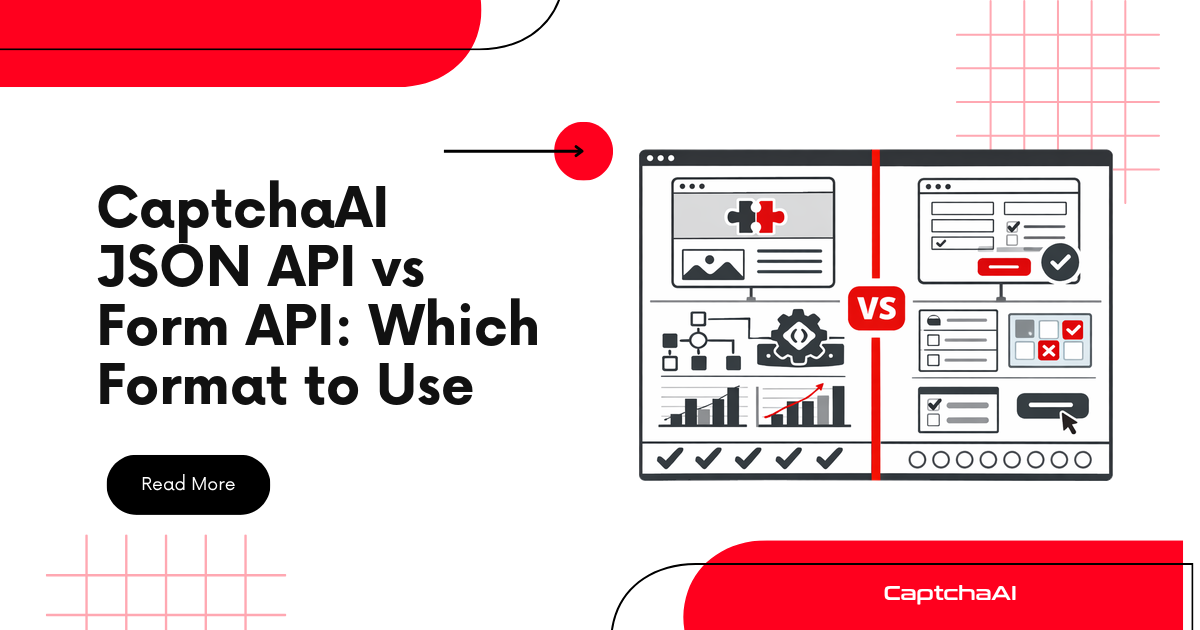
CaptchaAI accepts requests in both form-encoded and JSON formats. Both work identically — choose based on your language and preferences.
Side-by-Side Comparison
Form-Encoded (Default)
import requests

resp = requests.post("https://ocr.captchaai.com/in.php", data={
    "key": "YOUR_API_KEY",
    "method": "userrecaptcha",
    "googlekey": "SITE_KEY",
    "pageurl": "https://example.com",
    "json": 1,
})
Content-Type: application/x-www-form-urlencoded
JSON
import requests

resp = requests.post("https://ocr.captchaai.com/in.php", json={
    "key": "YOUR_API_KEY",
    "method": "userrecaptcha",
    "googlekey": "SITE_KEY",
    "pageurl": "https://example.com",
    "json": 1,
})
Content-Type: application/json
Key Differences
| Factor | Form-Encoded | JSON |
|---|---|---|
| Content-Type | application/x-www-form-urlencoded |
application/json |
| Data structure | Flat key-value pairs | Nested objects possible |
| Binary data | Use multipart for file upload | Base64 encode in body field |
| Array support | Limited | Native |
| Python keyword | data={} |
json={} |
| Node.js | URLSearchParams |
JSON.stringify() |
| Readability | Simple for flat params | Better for complex data |
| Compatibility | Works everywhere | Works everywhere |
Response Format
Add json=1 to get JSON responses regardless of request format:
# Without json=1 — plain text response
resp = requests.post("https://ocr.captchaai.com/in.php", data={
    "key": "YOUR_API_KEY",
    "method": "userrecaptcha",
    "googlekey": "SITE_KEY",
    "pageurl": "https://example.com",
})
# Response: "OK|12345678"

# With json=1 — JSON response
resp = requests.post("https://ocr.captchaai.com/in.php", data={
    "key": "YOUR_API_KEY",
    "method": "userrecaptcha",
    "googlekey": "SITE_KEY",
    "pageurl": "https://example.com",
    "json": 1,
})
# Response: {"status": 1, "request": "12345678"}
Always use json=1 for easier parsing.
Python Examples
Form-Encoded
import requests

# Submit
resp = requests.post("https://ocr.captchaai.com/in.php", data={
    "key": "YOUR_API_KEY",
    "method": "userrecaptcha",
    "googlekey": "SITE_KEY",
    "pageurl": "https://example.com",
    "json": 1,
})
task_id = resp.json()["request"]

# Poll (always GET with query params)
resp = requests.get("https://ocr.captchaai.com/res.php", params={
    "key": "YOUR_API_KEY",
    "action": "get",
    "id": task_id,
    "json": 1,
})
JSON Body
import requests

# Submit with JSON
resp = requests.post("https://ocr.captchaai.com/in.php", json={
    "key": "YOUR_API_KEY",
    "method": "userrecaptcha",
    "googlekey": "SITE_KEY",
    "pageurl": "https://example.com",
    "json": 1,
})
task_id = resp.json()["request"]

# Poll (same as form-encoded — GET with params)
resp = requests.get("https://ocr.captchaai.com/res.php", params={
    "key": "YOUR_API_KEY",
    "action": "get",
    "id": task_id,
    "json": 1,
})
Node.js Examples
Form-Encoded
const axios = require('axios');
const qs = require('querystring');

// Submit
const resp = await axios.post(
  'https://ocr.captchaai.com/in.php',
  qs.stringify({
    key: 'YOUR_API_KEY',
    method: 'userrecaptcha',
    googlekey: 'SITE_KEY',
    pageurl: 'https://example.com',
    json: 1,
  })
);
const taskId = resp.data.request;
JSON Body
const axios = require('axios');

// Submit with JSON
const resp = await axios.post(
  'https://ocr.captchaai.com/in.php',
  {
    key: 'YOUR_API_KEY',
    method: 'userrecaptcha',
    googlekey: 'SITE_KEY',
    pageurl: 'https://example.com',
    json: 1,
  }
);
const taskId = resp.data.request;
Image CAPTCHA: Form vs JSON
For image CAPTCHAs, the format matters more:
Form with File Upload (Multipart)
# File upload — form-encoded with multipart
resp = requests.post("https://ocr.captchaai.com/in.php",
    data={
        "key": "YOUR_API_KEY",
        "method": "post",
        "json": 1,
    },
    files={
        "file": open("captcha.png", "rb"),
    },
)
JSON with Base64
import base64

# Base64 in JSON body
with open("captcha.png", "rb") as f:
    body = base64.b64encode(f.read()).decode()

resp = requests.post("https://ocr.captchaai.com/in.php", json={
    "key": "YOUR_API_KEY",
    "method": "base64",
    "body": body,
    "json": 1,
})
Form with Base64
# Base64 in form data
resp = requests.post("https://ocr.captchaai.com/in.php", data={
    "key": "YOUR_API_KEY",
    "method": "base64",
    "body": body,
    "json": 1,
})
When to Use Which
| Scenario | Recommended | Why |
|---|---|---|
| Simple scripts | Form-encoded | Simpler, fewer dependencies |
| REST API integration | JSON | Matches typical API patterns |
| File uploads | Multipart form | Direct binary upload |
| Large base64 images | Form-encoded | Better handling of large payloads |
| TypeScript/modern JS | JSON | Native object support |
| Legacy system integration | Form-encoded | Universal compatibility |
| Migrating from 2Captcha | Form-encoded | Same format as 2Captcha |
Common Mistakes
| Mistake | Problem | Fix |
|---|---|---|
Using json={} but no json: 1 in data |
Response is plain text | Include "json": 1 in the data |
Mixing data= and json= in Python requests |
Request malformed | Use one or the other |
| Forgetting Content-Type header | Server can't parse body | Let your HTTP library set it automatically |
| Sending JSON body to poll endpoint | Poll uses GET params | Always use GET with query params for /res.php |
FAQ
Does the format affect solving speed or accuracy?
No. Both formats produce identical results. The server processes them the same way.
Can I mix formats in the same project?
Yes. You can submit with JSON and poll with query params (which is how polling always works). Each request is independent.
Which format is used by the 2Captcha-compatible API?
The original 2Captcha API uses form-encoded. CaptchaAI adds JSON support on top. If you're migrating from 2Captcha, stick with form-encoded.
Related Guides
Choose your preferred format — try CaptchaAI API today.


Discussions (0)
Join the conversation
Sign in to share your opinion.
Sign InNo comments yet.