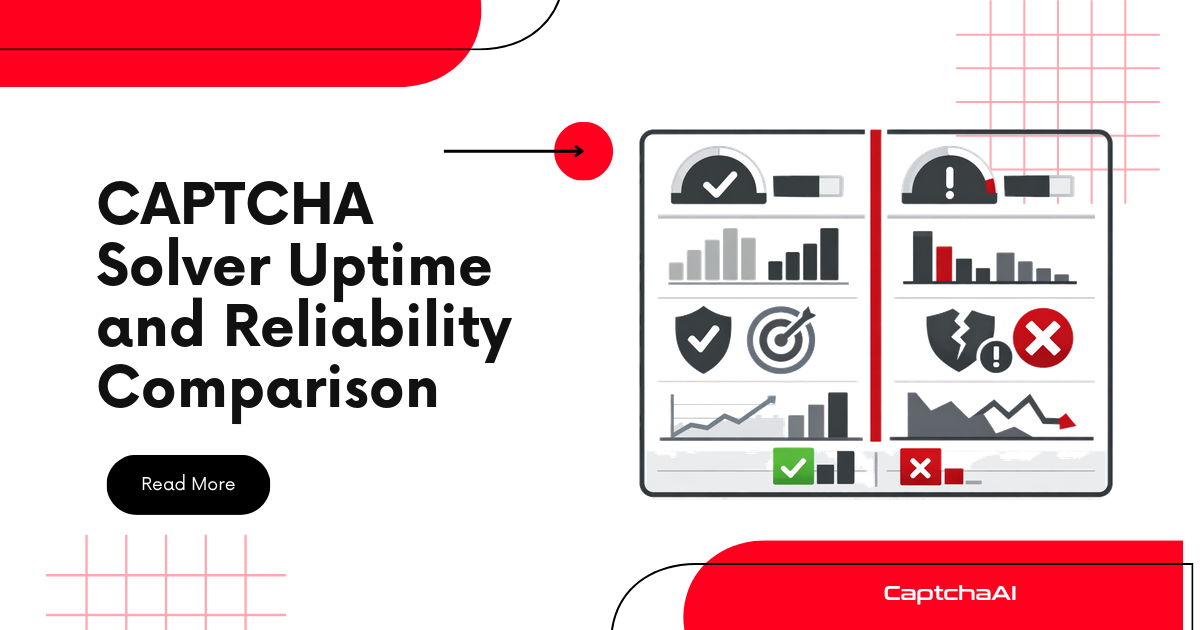
When your scraping pipeline depends on a CAPTCHA solving API, downtime means lost data, broken workflows, and missed business opportunities. This guide compares reliability across major providers.
Why Reliability Matters
Your pipeline:
  Scrape page ──▶ Hit CAPTCHA ──▶ Call API ──▶ Get token ──▶ Continue

If CAPTCHA API is down:
  Scrape page ──▶ Hit CAPTCHA ──▶ Call API ──▶ TIMEOUT ──▶ Pipeline stalls

Impact:

  - Data collection halts
  - Scheduled jobs fail
  - Business insights delayed
  - Competitive advantage lost
Reliability Factors
1. Architecture Type
| Provider | Architecture | Impact |
|---|---|---|
| CaptchaAI | AI/ML models on redundant infrastructure | Consistent, no human bottleneck |
| 2Captcha | Human workers + queue system | Dependent on worker availability |
| Anti-Captcha | Human workers + AI hybrid | Partially dependent on workers |
| CapSolver | AI-powered | Generally consistent |
| CapMonster Cloud | AI-powered | Generally consistent |
Human-dependent services face inherent reliability risks:
- Worker shortages during holidays/weekends
- Queue buildup during demand spikes
- Quality variation between workers
2. Performance by Time of Day
AI-based services (CaptchaAI):
  00:00  ████████████████████  12s avg
  06:00  ████████████████████  12s avg
  12:00  ████████████████████  13s avg
  18:00  ████████████████████  13s avg

Human-based services (2Captcha):
  00:00  ██████████████████████████████  45s avg (fewer workers)
  06:00  ████████████████████████  25s avg
  12:00  ████████████████████  18s avg (peak workers)
  18:00  ██████████████████████████  30s avg
3. Weekend and Holiday Performance
| Scenario | CaptchaAI | Human Services |
|---|---|---|
| Normal weekday | ✅ Standard | ✅ Standard |
| Weekend | ✅ Same speed | ⚠️ 20-40% slower |
| Major holiday | ✅ Same speed | ❌ 50-100% slower |
| Black Friday/event surge | ✅ Minor queue | ❌ Severe degradation |
Success Rate Comparison
reCAPTCHA v2
| Provider | Success Rate | Consistency |
|---|---|---|
| CaptchaAI | 95%+ | ±2% variance |
| 2Captcha | 90-95% | ±8% variance |
| Anti-Captcha | 90-95% | ±6% variance |
| CapSolver | 90-95% | ±4% variance |
Cloudflare Turnstile
| Provider | Success Rate | Consistency |
|---|---|---|
| CaptchaAI | High | minimal variance |
| 2Captcha | 80-90% | ±10% variance |
| Anti-Captcha | 85-90% | ±8% variance |
| CapSolver | 85-95% | ±6% variance |
GeeTest v3
| Provider | Success Rate | Consistency |
|---|---|---|
| CaptchaAI | High | minimal variance |
| 2Captcha | 85-92% | ±6% variance |
| Anti-Captcha | 85-90% | ±8% variance |
| CapSolver | 88-95% | ±5% variance |
Building for Reliability
Even reliable services have occasional issues. Build your pipeline to handle them:
import requests
import time
import logging

logger = logging.getLogger(__name__)


class ReliableSolver:
    """CAPTCHA solver with retry, timeout, and health tracking."""

    def __init__(self, api_key, max_retries=3, poll_timeout=120):
        self.api_key = api_key
        self.base_url = "https://ocr.captchaai.com"
        self.max_retries = max_retries
        self.poll_timeout = poll_timeout
        self.stats = {"success": 0, "timeout": 0, "error": 0}

    def solve(self, method, **params):
        for attempt in range(self.max_retries):
            try:
                token = self._attempt_solve(method, **params)
                self.stats["success"] += 1
                return token
            except TimeoutError:
                self.stats["timeout"] += 1
                logger.warning(
                    "Solve timeout (attempt %d/%d)",
                    attempt + 1, self.max_retries,
                )
                time.sleep(2 ** attempt)
            except requests.RequestException as e:
                self.stats["error"] += 1
                logger.error("API error: %s", e)
                time.sleep(2 ** attempt)

        raise RuntimeError(f"All {self.max_retries} attempts failed")

    def _attempt_solve(self, method, **params):
        data = {
            "key": self.api_key,
            "method": method,
            "json": 1,
        }
        data.update(params)

        resp = requests.post(
            f"{self.base_url}/in.php", data=data, timeout=30
        )
        resp.raise_for_status()
        result = resp.json()

        if result.get("status") != 1:
            raise RuntimeError(f"Submit error: {result.get('request')}")

        task_id = result["request"]
        return self._poll_result(task_id)

    def _poll_result(self, task_id):
        start = time.time()
        while time.time() - start < self.poll_timeout:
            time.sleep(5)
            resp = requests.get(f"{self.base_url}/res.php", params={
                "key": self.api_key,
                "action": "get",
                "id": task_id,
                "json": 1,
            }, timeout=15)

            data = resp.json()
            if data["request"] == "CAPCHA_NOT_READY":
                continue
            if data.get("status") == 1:
                return data["request"]
            raise RuntimeError(f"Solve error: {data['request']}")

        raise TimeoutError("Poll timeout")

    def get_uptime_stats(self):
        total = sum(self.stats.values())
        if total == 0:
            return {"uptime": "N/A", "total": 0}
        success_rate = self.stats["success"] / total * 100
        return {
            "uptime": f"{success_rate:.1f}%",
            "total": total,
            **self.stats,
        }


# Usage
solver = ReliableSolver("YOUR_API_KEY")

token = solver.solve(
    "userrecaptcha",
    googlekey="SITE_KEY",
    pageurl="https://example.com",
)

print(solver.get_uptime_stats())
Health Monitoring
Track your CAPTCHA API's actual performance over time:
import csv
import datetime


class SolverMonitor:
    """Log solve attempts to CSV for reliability analysis."""

    def __init__(self, solver, log_file="solver_metrics.csv"):
        self.solver = solver
        self.log_file = log_file
        self._init_log()

    def _init_log(self):
        with open(self.log_file, "a", newline="") as f:
            writer = csv.writer(f)
            if f.tell() == 0:
                writer.writerow([
                    "timestamp", "method", "duration_s",
                    "status", "error",
                ])

    def solve(self, method, **params):
        start = time.time()
        status = "success"
        error = ""

        try:
            token = self.solver.solve(method, **params)
            return token
        except Exception as e:
            status = "error"
            error = str(e)
            raise
        finally:
            duration = time.time() - start
            self._log(method, duration, status, error)

    def _log(self, method, duration, status, error):
        with open(self.log_file, "a", newline="") as f:
            writer = csv.writer(f)
            writer.writerow([
                datetime.datetime.utcnow().isoformat(),
                method, f"{duration:.2f}",
                status, error,
            ])
Failover Strategy
For critical pipelines, use a secondary provider as backup:
class FailoverSolver:
    """Try primary solver first, fall back to secondary."""

    def __init__(self, primary_key, secondary_key):
        self.primary = ReliableSolver(primary_key, max_retries=2)
        self.secondary = ReliableSolver(secondary_key, max_retries=2)
        self.secondary.base_url = "https://backup-solver.example.com"

    def solve(self, method, **params):
        try:
            return self.primary.solve(method, **params)
        except RuntimeError:
            logger.warning("Primary failed, trying secondary")
            return self.secondary.solve(method, **params)
Troubleshooting
| Issue | Cause | Fix |
|---|---|---|
| Timeouts during peak hours | Provider overloaded | Switch to AI-based service, increase poll timeout |
| Success rate dropped suddenly | CAPTCHA type changed on target site | Check if method parameter is still correct |
| Intermittent connection errors | Network issues | Add retry logic with exponential backoff |
| Slow responses at night | Human workers offline | Use AI-based provider (CaptchaAI) |
FAQ
Which CAPTCHA solver has the best uptime?
AI-powered services like CaptchaAI maintain consistent performance 24/7. Human-dependent services experience degradation during off-peak hours, weekends, and holidays.
How do I monitor my CAPTCHA solver's reliability?
Log every solve attempt with timestamp, duration, and status. Analyze patterns over time. The SolverMonitor class above provides a ready-to-use solution.
Should I use multiple CAPTCHA solving providers?
For mission-critical pipelines, yes. Use a primary/secondary failover strategy. CaptchaAI as primary with a secondary backup ensures maximum uptime.
Related Guides
Choose reliability — try CaptchaAI for consistent, 24/7 CAPTCHA solving.