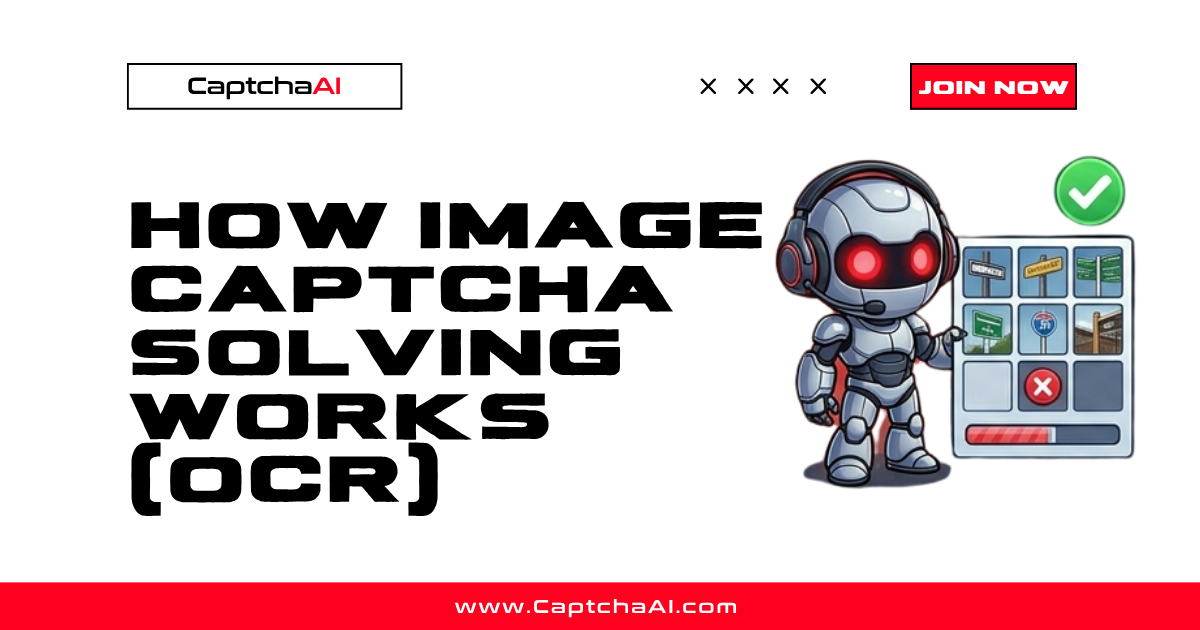
Image CAPTCHAs render distorted text in an image and ask users to type what they see. Automated solving uses Optical Character Recognition (OCR) — pattern recognition that converts image pixels into text characters.
How text CAPTCHAs create difficulty
CAPTCHA images use multiple distortion techniques to defeat OCR:
| Technique | How it works | Effect on OCR |
|---|---|---|
| Character warping | Letters bent, stretched, rotated | Breaks template matching |
| Overlapping characters | Letters overlap each other | Makes segmentation difficult |
| Background noise | Random dots, lines, patterns | Confuses edge detection |
| Color variation | Different colors for text and noise | Breaks single-threshold binarization |
| Variable fonts | Mixed font families and sizes | Prevents consistent template matching |
| Line strikes | Lines drawn through text | Fragments character shapes |
| JPEG artifacts | Low quality compression | Blurs character edges |
How OCR solves CAPTCHAs
Traditional OCR pipeline
Image → Preprocessing → Segmentation → Recognition → Text
- Preprocessing — Convert to grayscale, remove noise, enhance contrast
- Binarization — Convert to black/white using adaptive thresholding
- Segmentation — Isolate individual characters
- Recognition — Match each character against a trained model
- Post-processing — Apply dictionary/grammar corrections
Neural network approach (modern)
Image → CNN Feature Extraction → RNN Sequence Modeling → CTC Decoding → Text
Modern solvers skip segmentation entirely. Convolutional Neural Networks (CNNs) extract visual features. Recurrent Neural Networks (RNNs) with CTC (Connectionist Temporal Classification) decode the character sequence directly from the feature map.
Why local OCR fails on CAPTCHAs
Standard OCR tools (Tesseract, EasyOCR) are designed for clean document text. CAPTCHAs are specifically designed to defeat them:
| Feature | Document OCR | CAPTCHA |
|---|---|---|
| Text clarity | Clean, high-contrast | Distorted, noisy |
| Character spacing | Regular | Overlapping |
| Background | White/plain | Complex patterns |
| Font consistency | Uniform | Variable |
| Accuracy needed | ~95% usable | ~100% required |
If any character is wrong, the entire CAPTCHA solution fails. A 95% per-character accuracy means a 6-character CAPTCHA has only a 73% success rate (0.95^6).
API-based solving vs local OCR
| Approach | Accuracy | Speed | Cost |
|---|---|---|---|
| Tesseract on CAPTCHA | 10–40% | Instant | Free |
| Custom CNN model | 60–85% | Instant | Training cost |
| CaptchaAI API | ~95%+ | 5–15 sec | Per-thread (unlimited solves) |
| Manual human solving | ~99% | 10–30 sec | Per-thread (unlimited solves) |
CaptchaAI achieves high accuracy by combining specialized ML models trained specifically on CAPTCHA images with human verification for difficult cases.
Common CAPTCHA image types
Simple text CAPTCHA
┌──────────────────┐
│   a K 3 m P 7    │  ← Letters and numbers, minimal distortion
└──────────────────┘
Heavily distorted
┌──────────────────┐
│ ▓░▒a░K▒3▓m░P▒7░ │  ← Noise, warping, overlapping
└──────────────────┘
Math CAPTCHA
┌──────────────────┐
│    3 + 7 = ?     │  ← User must compute: answer is 10
└──────────────────┘
Multiline CAPTCHA
┌──────────────────┐
│   Select the     │
│   red word:      │
│  apple  DOG      │  ← User types "DOG" (shown in red)
└──────────────────┘
Solving with CaptchaAI
import requests
import time
import base64

# Read and encode the image
with open("captcha.png", "rb") as f:
    img_b64 = base64.b64encode(f.read()).decode()

# Submit
resp = requests.post("https://ocr.captchaai.com/in.php", data={
    "key": "YOUR_API_KEY",
    "method": "base64",
    "body": img_b64,
    "json": 1
}).json()

task_id = resp["request"]

# Poll
for _ in range(30):
    time.sleep(5)
    result = requests.get("https://ocr.captchaai.com/res.php", params={
        "key": "YOUR_API_KEY", "action": "get", "id": task_id, "json": 1
    }).json()
    if result.get("status") == 1:
        print(f"Text: {result['request']}")
        break
FAQ
Is OCR CAPTCHA still used?
Yes. Many legacy systems, government websites, and smaller sites still use text-based image CAPTCHAs because they are simple to implement.
Can I train my own model instead of using an API?
Yes, but you need thousands of labeled CAPTCHA examples from the specific site. The model must be retrained if the site changes its CAPTCHA style. API services handle this maintenance for you.
What about CAPTCHAs with colored text?
CaptchaAI handles colored text CAPTCHAs. For local OCR, preprocessing must preserve text while removing colored noise — significantly harder than grayscale CAPTCHAs.
How do I report wrong answers?
Send a report to https://ocr.captchaai.com/res.php?key=KEY&action=reportbad&id=TASK_ID. This improves solver accuracy and may refund the solve cost.