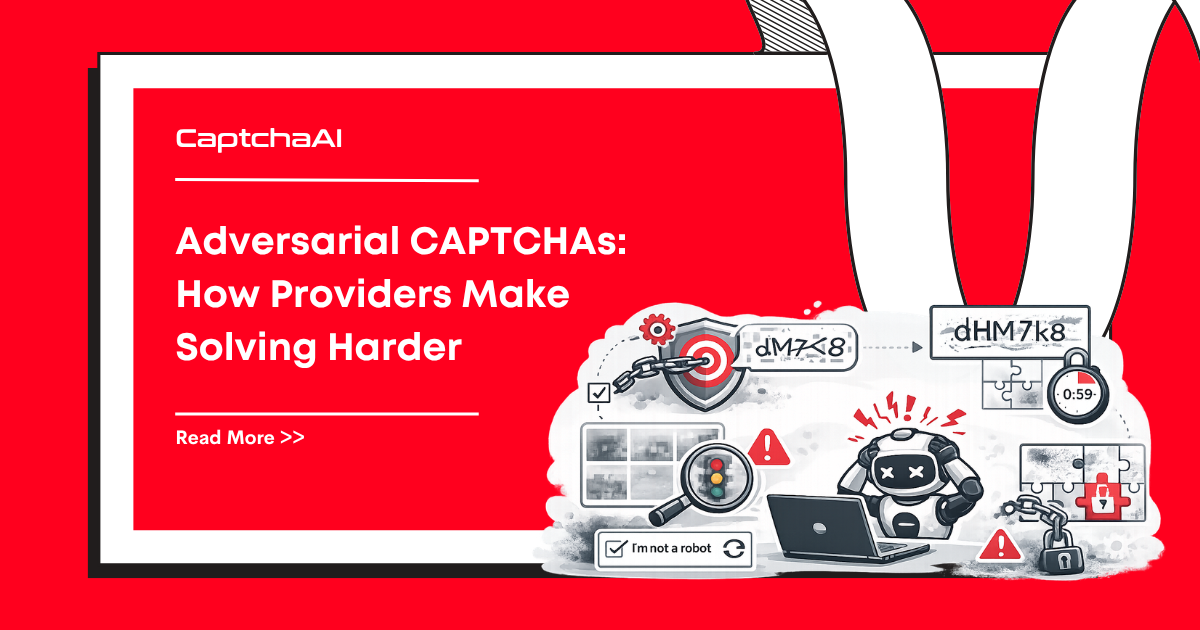
CAPTCHA providers are engaged in an ongoing contest with solvers. As machine learning models get better at solving challenges, providers deploy adversarial techniques — deliberate modifications designed to break automated solving while remaining solvable by humans.
The Adversarial Approach
Traditional CAPTCHAs relied on the gap between human and machine vision. Modern adversarial CAPTCHAs go further — they exploit specific weaknesses in machine learning models:
| Generation | Approach | Weakness Exploited |
|---|---|---|
| First (2000s) | Distorted text | OCR accuracy on warped characters |
| Second (2010s) | Image classification | Object detection in varied contexts |
| Third (2020s) | Behavioral analysis | Browser automation detection |
| Current | Multi-signal, adaptive | Model-specific adversarial patterns |
Visual Adversarial Techniques
Image-Level Attacks
| Technique | How It Works | Impact on Solvers |
|---|---|---|
| Adversarial noise | Add imperceptible pixel perturbations | Causes misclassification in CNNs while looking normal to humans |
| Deformable grids | Warp grid lines so tiles don't align cleanly | Confuses tile segmentation algorithms |
| Graduated difficulty | Serve harder images when automated solving is detected | Increases failure rate for persistent bots |
| Semantic ambiguity | Use borderline examples ("Is this a car or a truck?") | Forces errors at classification boundaries |
| Multi-object tiles | Place target and non-target objects in same tile | Confusion between "contains object" vs. "primarily shows object" |
Text-Level Attacks
| Technique | Impact |
|---|---|
| Character overlap | Prevents segmentation-based approaches |
| Anti-aliasing manipulation | Disrupts edge detection used by OCR |
| Dynamic font generation | New fonts with each challenge prevent template matching |
| Stroke-level perturbation | Modified individual strokes that humans recognize but models don't |
| 3D text rendering | Perspective and lighting effects that flat-image models struggle with |
Behavioral Adversarial Techniques
Modern CAPTCHAs go beyond the visual challenge. They analyze how you interact:
Mouse/Touch Dynamics
CAPTCHA providers track:
- Movement trajectory — Humans move in curves; bots move in straight lines
- Speed variance — Humans accelerate and decelerate; bots move at constant speed
- Micro-corrections — Humans overshoot and correct; bots hit targets precisely
- Hover patterns — Humans linger on options; bots click immediately
Browser Environment
| Signal | Human | Automated |
|---|---|---|
| Canvas fingerprint | Consistent with GPU/OS | Spoofed or headless renderer |
| WebGL renderer | Real GPU | "SwiftShader" or missing |
| Plugin list | Browser-appropriate | Empty or inconsistent |
| Timing between actions | Variable (100–2000ms) | Consistent (exact intervals) |
| Screen resolution | Standard sizes | Unusual or headless defaults |
Risk Scoring
reCAPTCHA v3 doesn't show a challenge at all — it generates a risk score (0.0 to 1.0) based on behavioral signals. The site owner decides the threshold:
| Score Range | Interpretation | Common Action |
|---|---|---|
| 0.9–1.0 | Likely human | Allow through |
| 0.5–0.8 | Uncertain | Show secondary verification |
| 0.1–0.4 | Likely automated | Block or show challenge |
| 0.0–0.1 | Almost certainly a bot | Block entirely |
Adaptive Difficulty
Modern CAPTCHA systems adjust difficulty based on risk signals:
Low Risk User                    High Risk User
─────────────                    ──────────────
Single checkbox click            Multi-round image challenge
→ Pass immediately               → 3-5 sets of image grids
                                 → Fading images (load slowly)
                                 → New images appear after selection
Triggers for Increased Difficulty
| Signal | Difficulty Increase |
|---|---|
| Same IP solving many CAPTCHAs | Harder challenges, more rounds |
| Known datacenter IP range | Maximum difficulty |
| Fast solve time | Additional verification rounds |
| Failed challenges then succeeds | Suspicious — escalate |
| Browser fingerprint mismatch | Maximum difficulty |
Anti-Solving Service Techniques
Some providers specifically target solving services:
| Technique | Mechanism |
|---|---|
| Honeypot challenges | Serve impossible-to-solve CAPTCHAs to detect API-based solving |
| Token fingerprinting | Tie the solution token to the browser session that received the challenge |
| time-boxed tokens | Tokens expire faster when risk is high (30s instead of 120s) |
| Challenge-response binding | Token only valid if the same browser instance submits it |
| Rate-based blocking | Detect high-volume solving patterns and block the site key |
How Solving Services Adapt
CAPTCHA solving services like CaptchaAI counter these techniques:
| Adversarial Technique | Counter-Approach |
|---|---|
| Visual adversarial noise | Continuous retraining on new challenge samples |
| Behavioral detection | Real browser environments with human-like interaction |
| Adaptive difficulty | High-quality proxies and residential IPs to reduce risk score |
| Token fingerprinting | Proper browser context for token generation |
| New CAPTCHA types | Rapid model development and deployment for new challenges |
CaptchaAI maintains solve rates by continuously updating models and using real browser environments that generate valid behavioral signals.
What This Means for Developers
The adversarial landscape has practical implications:
- Solve rates fluctuate — Provider updates cause temporary accuracy dips until solving services retrain
- Speed varies — Harder challenges take longer to solve
- Proxy quality matters — Residential proxies get easier challenges than datacenter IPs
- Cookies help — Sending cookies from legitimate sessions reduces challenge difficulty
- User-Agent consistency — Matching your headers to expected patterns improves scores
Troubleshooting
| Issue | Cause | Fix |
|---|---|---|
| Solve rate suddenly drops | CAPTCHA provider deployed new adversarial update | Wait for solving service to retrain; usually resolves in 24–48 hours |
| Getting harder challenges than usual | Flagged IP or session | Rotate proxies; use residential IPs; clear cookies |
| reCAPTCHA v3 scores too low | Behavioral signals detected as automated | Send cookies, use real User-Agent, use headed browser |
| Multiple rounds of image challenges | High risk score triggering adaptive difficulty | Improve proxy quality; reduce solving frequency per IP |
FAQ
Will adversarial CAPTCHAs eventually be unsolvable?
Unlikely. The constraint is that humans must still solve them. Any challenge solvable by humans can eventually be solved by AI — it's a matter of training data and model capacity. The arms race continues, but it's an escalation, not an end state.
Do adversarial techniques affect all CAPTCHA types equally?
No. Visual challenges (grid images, text) face visual adversarial techniques. Behavioral CAPTCHAs (reCAPTCHA v3, Turnstile) focus on environmental and interaction signals. The solving approach differs for each.
How quickly do solving services adapt to new adversarial techniques?
Major providers typically adapt within days to weeks. CaptchaAI continuously monitors solve rates and retrains models when accuracy drops, minimizing disruption to your workflows.
Next Steps
Stay ahead of adversarial CAPTCHAs — use CaptchaAI to handle evolving challenges automatically.
Related guides:
Discussions (0)
Join the conversation
Sign in to share your opinion.
Sign InNo comments yet.